Remarques complètes de notre fondateur, Tony O. Elumelu CFR, à l'occasion de l'émission Global Perspective on Africa de CNN à Londres
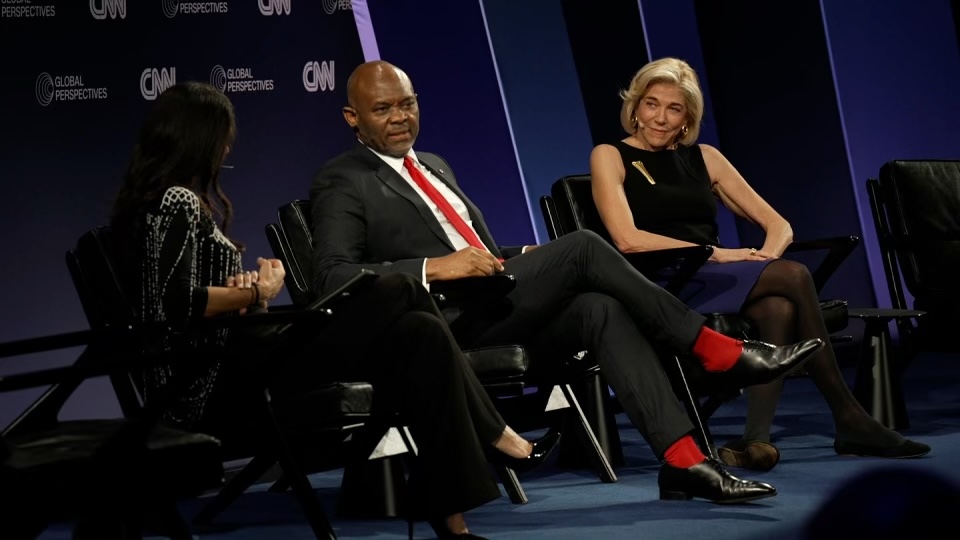
In November 2025, Tony O. Elumelu, CFR, Founder of The Tony Elumelu Foundation, joined Lady Lynn Forester de Rothschild, Founder and CEO of the Council for Inclusive Capitalism, for a powerful dialogue moderated by CNN’s Eleni Giokos, on Africapitalism and the new era of inclusive finance, at CNN’s Global Perspectives on Africa in London.
Together, they delved into how Africa’s private sector and entrepreneurs are driving sustainable, inclusive growth and reshaping global market systems from the continent’s unique perspective.
- The global economy has faced a lot of crises in the past few decades: crises of inequality, crises of exclusion, and, of course, in recent times, environmental stress. It is against this background that we came up with this whole philosophy and concept of Africapitalism.
- And I must say that it’s not an African adaptation of capitalism. It is a redefinition of capitalism to address the germane issues that Lady Lynn just talked about. We believe that the private sector must play a critical role in creating economic prosperity and social transformation for society, for humanity.
- We believe that in the 21st century, capitalism must be centred on community involvement, community inclusion. We believe, to a large extent, that profit and purpose are not in rivalry. There’s no rivalry between both.
- Profit and purpose are partners, especially in the African Renaissance, talking about capitalism in the world today. To us, getting the private sector to invest is not about charity per se, but to invest in critical sectors that help to create economic prosperity, and social transformation is what we need.
- I think that inclusive capitalism is not about charity. It’s about value creation. It’s about inclusion. It’s about making sure that businesses don’t work for profit alone, don’t work for shareholders alone; that they work, and at the core, what they do is community. So, what we do at the Tony Elumelu Foundation, to us, to me, my wife, and, by the way, Lynn was a founding board member of the Tony Elumelu Foundation.
- She sat on the board for 12 years. So, our interest in humanity did not start today. We thought and realized that our success is not defined by the wealth or the money we have in our bank accounts.
- We thought we couldn’t be successful if we did not play our own role in helping to catalyze economic prosperity for all on the continent of Africa. But we realized that we can’t do it alone, and that’s why we’re not going on that journey alone. We go with people.
- We identify young African entrepreneurs every year. We provide non-refundable capital of $5,000 between 3,000 and 5,000 young Africans every year, all across African countries every year, and that is Africapitalism.
- That is private sector. But when we talk of private sector investment, it’s not just in fiscal infrastructure, but investing in young people is an investment that helps to catalyze more prosperity.
- Let me start by saying that Africapitalism moves us away from extraction to creation. It moves us away from consumption to production. And it moves us from dependency to dignity.
- I think it’s all about long-term interest: the interest of Africa is one that we have, will create local value on the continent.
- We move away from exportation of raw materials. We create—Africa has significant youth unemployment. I call it a betrayal of the young generation in Africa that we cannot create jobs for them.
- So, in seeking to align with powers or economies of the world, developed economies, there should be first an alignment of our long-term interest: job creation, youth empowerment, inclusivity, inclusion. Which of the global economies best offers or helps our attainment of these core objectives? To me, that would define how we align.
- Africa needs massive investment in infrastructure to transform the continent. We talk about AI; I just came back from a conversation in Riyadh about AI, and my position is consistent.
- Africa should not even talk about AI when access to common electricity is not available on the continent. So, we need alignment with global partners, development agencies, private sector. And for me, it’s not African private sector.
- it’s Africa’s private sector: private sector that does business in Africa. We need to start rethinking, reimagining how we operate on the continent.
- We need to begin to see, and that’s why I’m 100% aligned with the intersection of community shareholders, value creation, everyone being on table.
- There’s no reason to align with people who come to the continent for the purpose of extraction of raw materials. We need that raw material processed on the continent so local value addition can be created, so that the youth unemployment that we have in Africa is addressed, so that capitalic intervention activities that help to propel and take Africa to the next level,that would define what we do or who I should be aligning with.
Watch the session here: https://youtu.be/atxv5LuBvig?si=kmGo_A_ehkc70arO