
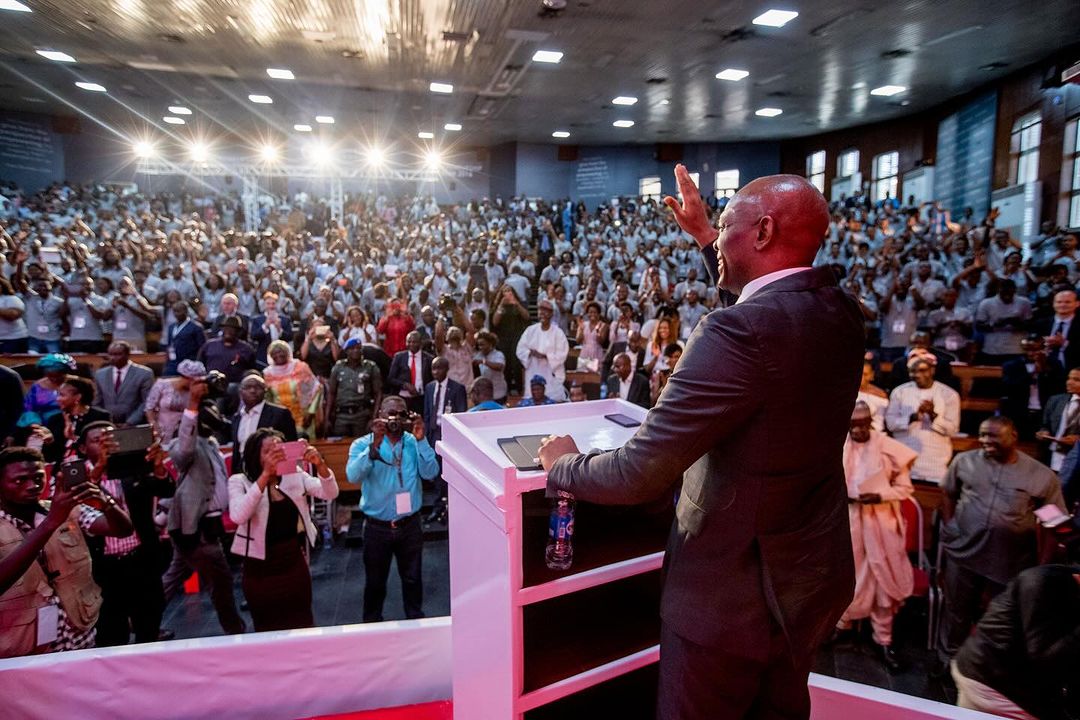
Our Founder, Tony O. Elumelu, CFR’s Keynote Remarks at the Castelfalfi Dialogues 2026: The Europe–Africa Strategic Dialogue Forum.
On 16 November 2026, our Founder, Tony O. Elumelu, CFR, delivered keynote remarks at the Castelfalfi Dialogues 2026, the Europe–Africa Strategic Dialogue Forum in Tuscany, Italy. Speaking on the future of Europe–Africa cooperation, he called for partnerships that move beyond the export of raw materials towards the development of integrated value chains that create lasting economic opportunity on the African continent. Highlighting opportunities across energy, electricity, critical minerals and entrepreneurship, he emphasised that Africa’s development must be driven by investment, value creation and the empowerment of African enterprises and entrepreneurs.
—-
Thank you, Shankar.
And thank you to the Lohia Group for bringing us to Tuscany – where people have been adding value to commodities for millennia.
Let’s keep that in mind – commodities and value creation.
It is a privilege to speak in a room that includes President Prodi, who has been making the case for a serious Europe–Africa partnership for decades.
I am an African and a globalist. I have built businesses that not only span Africa but operate in Europe, the United States and the Gulf. I know how closely related we all are – how our futures are tied.
I have been asked to talk on energy, critical materials and supply chain resilience.
The briefing paper says Europe and Africa have complementary strengths: Africa the resources, Europe the capital, technology and markets.
True.
It was also true in 1960 and in 1890, and Africa has yet to fundamentally benefit from this “complementarity”.
So let me say what the African private sector wants.
We will not be Europe’s raw-material diversification strategy. Europe lost Russian gas and has seen disruption in the Gulf. I understand that. But the Europe–Africa relationship cannot continue to be one of extractive dependency, with Africa as the reliable supplier of raw materials and little or no value created on the African continent.
What we will sign up to are integrated value chains.
The difference between a supply chain and a value chain is where the value is created – and value must be created in Africa. For the first time, Europe’s security interest and Africa’s industrial interest point the same way. Let us not waste it.
Which value chains, which opportunities, are critical now?
Gas first. Nigeria has around 200 trillion cubic feet of proven reserves. We flare a good deal of it, which is a scandal, and we export much of the rest as LNG. Through Heirs Energies, which I founded – and Wale Tinubu will say the same of Oando – we are producing gas today that goes into Nigerian power plants and Nigerian factories.
The European opportunity is not only to buy our LNG. It is to co-invest in the processing: the fertiliser plants, the petrochemicals, the gas-fired industrial parks.
Enrico Mattei, the founder of Eni, understood this seventy years ago: that Italy’s energy security and the producing country’s development had to be the same project. The Italian government has put his name on a plan for Africa, and I want to say to our Italian friends that the African private sector takes that seriously. We are ready to be partners.
Power second. Through my company Transcorp, we are one of Nigeria’s largest electricity generators with 2000MW installed capacity, and I can tell you the binding constraint on African industrialisation is not minerals or capital. It is electricity. Six hundred and fifty million Africans have none. No one builds a smelter or a data centre where the grid fails. European grid and renewables technology, deployed with African operators who know how to deliver, is the most bankable thing on this agenda.
Critical minerals third. Lithium, cobalt, graphite, manganese, rare earths. Africa has them. Europe needs them. And here I will be blunt: the Democratic Republic of Congo produces seventy per cent of the world’s cobalt and captures almost none of the value, because the refining happens elsewhere. If Europe wants a secure supply of battery materials that is not routed through a single competitor, the only durable way to get it is to put the refineries in Africa, with African equity and real African partners.
Let me add a fourth: human capital, Africa’s greatest asset. My foundation, the Tony Elumelu Foundation, is the largest supporter of young African entrepreneurs. In fifteen years, we have funded more than 24,000 young entrepreneurs across all 54 African countries, with more than US$120 million in seed capital. Each year we receive applications from hundreds of thousands. We now work with the EU, the UNDP, the ICRC and more, and we are looking for more partners. The biggest waste in Africa is the waste of young talent – too often forced to migrate at great personal cost, and at great cost to Africa’s future. We all need to invest in Africa’s youth.
Can value be created in Africa at scale? The answer is sitting in this room. Aliko Dangote built the largest single-train refinery in the world in Lagos, with African capital, against the advice of almost every expert, and Nigeria now exports refined products to Europe instead of importing them. That is the model.
You asked how to mobilise European capital at scale, and what role public finance should play. I have been raising capital in Europe for thirty years. Here is what I have learned.
European private capital is not afraid of Africa. It is afraid of being first and alone. That is the job of public finance and guarantees: take the first risk, so that private capital can follow. And then invest through African institutions, not around them. Benedict Oramah is here. Under his leadership Afreximbank became a fifty-billion-dollar institution that financed African enterprises and trade when nobody else would, and it did so with African shareholders. That is what an African institution at scale looks like, and there are others: African institutions like the African Finance Corporation (AFC) which I co-founded, United Bank for Africa – UBA which I chaired, African insurers and African funds with the balance sheets and the local knowledge to deploy. When European money arrives with its own intermediaries, its own law and its own arbitration seat, the project may get built, but the capability does not stay.
Let me end with the principle I have spent my life on.
I call it Africapitalism: the conviction that Africa’s private sector must lead the continent’s development, in partnership with those willing to invest rather than donate. This session is the test of whether Europe is such a partner.
You need our energy and minerals. We need your capital and technology. Neither of us needs the other’s charity. Build value chains that leave the refining, the processing and the equity in Africa, and Europe gets the only supply security that lasts: a supplier that is also prospering. If we do not, Africa will build them with someone else, and Europe will have been offered the chance first.
I would rather we built them together.
Thank you.
TOE